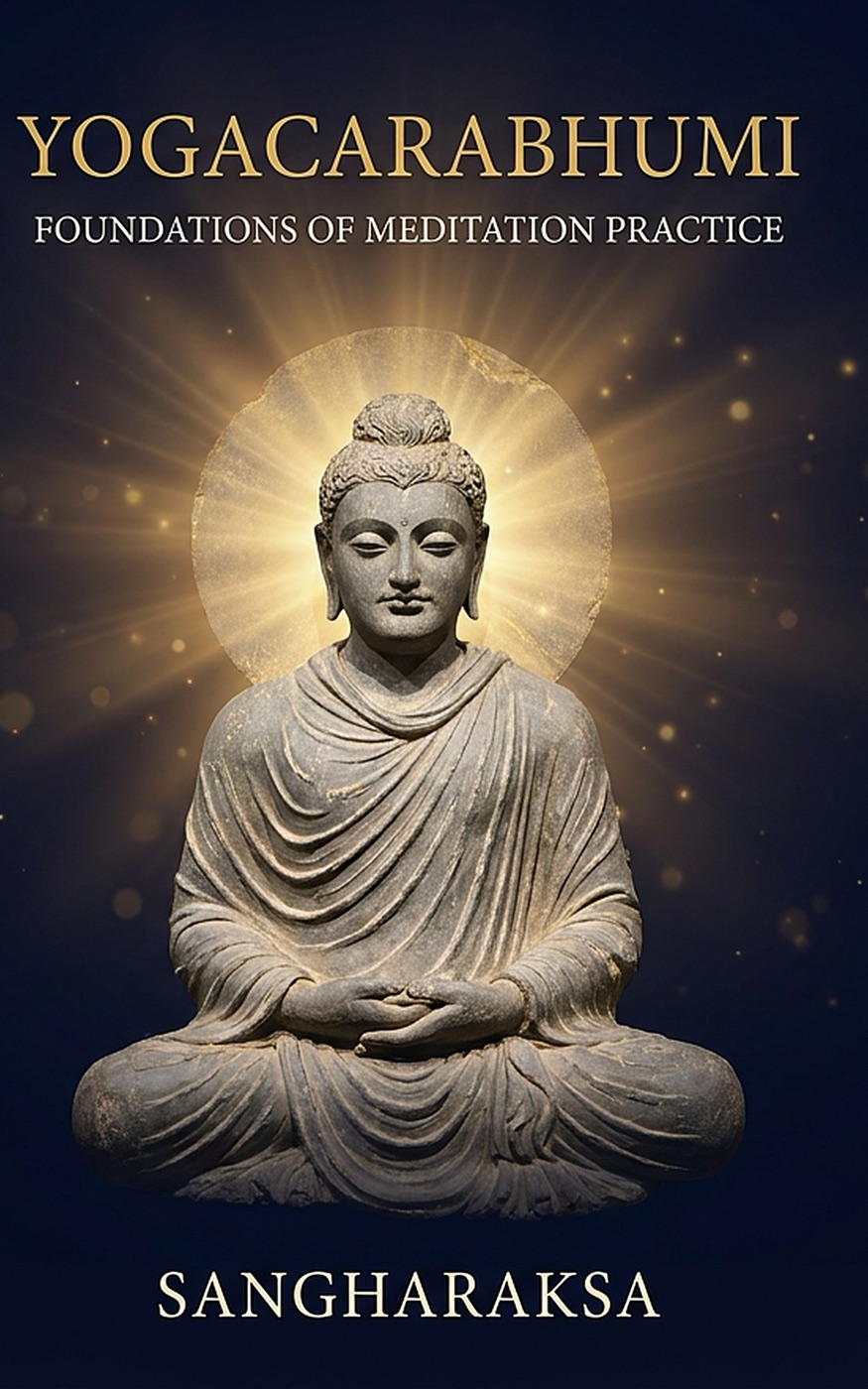
THE MEDITATION MANUAL OF CHINA’S FIRST MEDITATORS
Yogācārabhūmi
Foundations of Meditation Practice
- Pages
- 375
- Published
- 2026
- ISBN
- 979-8-18990-148-5
- Format
- Paperback & Hardcover
THE MEDITATION MANUAL OF CHINA’S FIRST MEDITATORS
Foundations of Meditation Practice
Around the turn of the first and second centuries, in Gandhāra — the Buddhist northwest, where Greek art met Indian thought — an elder named Saṅgharakṣa, a near-contemporary of the poet Aśvaghoṣa, set down a complete, step-by-step course in how to meditate.
The tradition later flowering as Zen learned to sit from books like this one. Yet in seventeen centuries it was never put into English — until now.from the book description
Its Sanskrit title was the Yogācārabhūmi, “the stages of one who practises yoga.” In 284 CE the great translator Dharmarakṣa carried it into Chinese as the Xiuxing daodi jing (修行道地經, Taishō 606), and it became one of the very first practical answers China ever received to a simple question: how, exactly, is this done? An earlier, partial version by An Shigao (T607) is collated throughout this edition.
This is the first complete English rendering: made to be read and used by anyone who actually meditates, and annotated for anyone who wants to know exactly where each teaching comes from. The English is meant to teach a living practitioner, sentence by living sentence — never a cryptic crib. Wherever the rendering goes beyond the letter, or leans on a parallel, an endnote gives the literal wording and the exact location.
Inside: the counting of the breath, caught near the moment of its making; loving-kindness, the guarding of the senses, the contemplation of death; the earliest known sorting of meditators by temperament; the great chapter on emptiness and non-self, carried by the canon’s most famous images — the mirage, the plantain with no core, the lute whose sound cannot be caught. Then the whole ascent to the arahant, and a later Mahāyāna coda built on two of the Lotus Sūtra’s greatest parables.
Some ninety canonical cross-references — in Pāli, Sanskrit, and Chinese — stand behind the notes, every one verified in its source. The companion volume is the Dharmatrāta Dhyāna Sūtra: the Kashmiri cousin, a century later, on the road that leads toward Chan.
COLOPHON
Small presses live on honest words from real readers. If this edition has been part of your practice or your study, an honest review on Amazon — whatever you truly think — helps the next reader find it.